
Construction Site Theft in Toronto: Why It Keeps Happening and How to Stop It
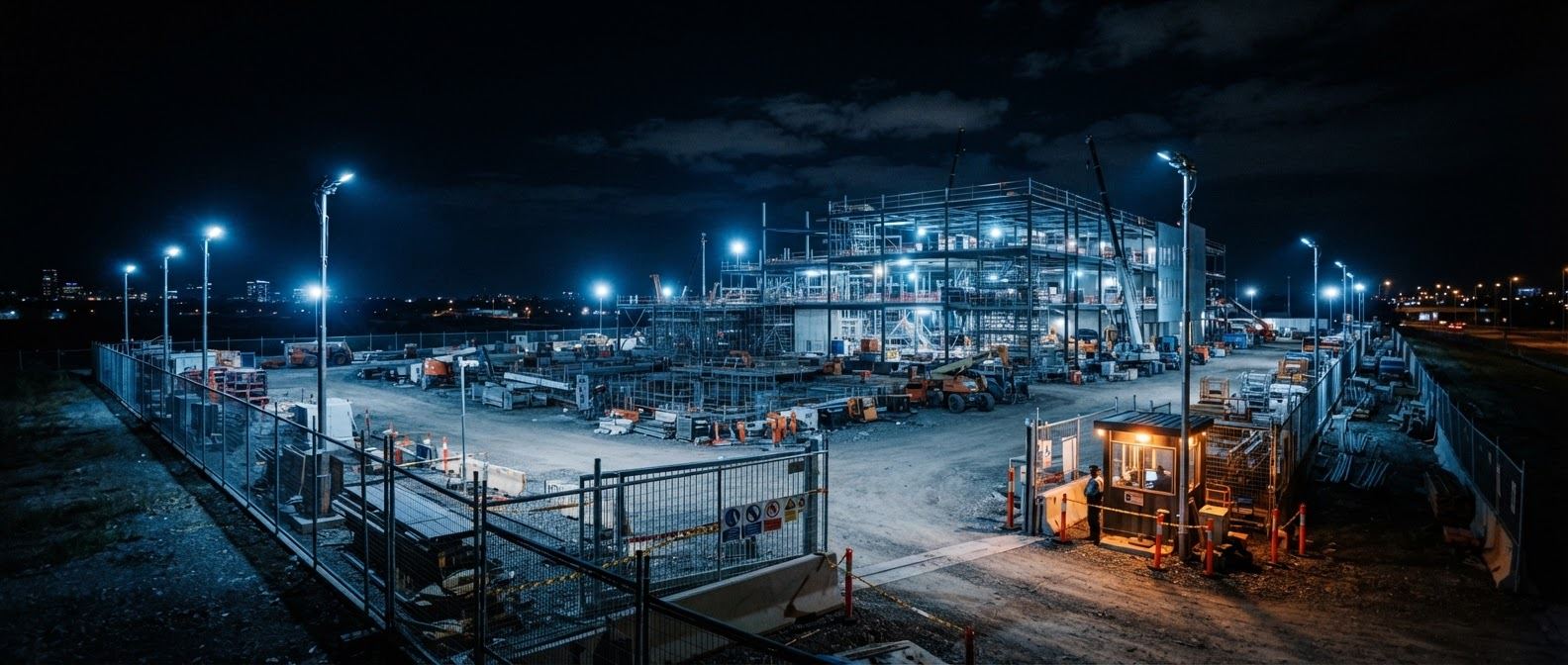
Ask any GTA site superintendent about theft and you'll hear a version of the same story: the crew locks up on Friday, and by Monday morning a generator is gone, copper wire has been stripped from a floor, or a skid steer has been driven straight through the fence line. The site was fenced. There were cameras. There were "No Trespassing" signs. None of it mattered.
This article breaks down why construction sites across Toronto, Vaughan, Brampton and Mississauga remain such reliable targets — and what a site team can actually do about it.
Why thieves love construction sites
From a thief's perspective, an active job site is close to an ideal target:
The schedule is public knowledge. Anyone who drives past a site twice knows exactly when the last trade leaves and when the first one arrives. That's an eight-to-twelve-hour window, every single night, with almost zero chance of encountering a person.
The goods are portable and untraceable. Copper wire, power tools, compressors, fuel and building materials rarely carry serial-number tracking that survives resale. Much of it is sold on within days.
Consequences are rare. By the time footage is reviewed on Monday, the trail is cold. Recorded video identifies almost no one — hoodies and gloves defeat it — and police can do little with a report filed 60 hours after the fact.
Why the usual deterrents underperform
Fencing and locks slow entry by seconds. Bolt cutters and cordless grinders are standard kit for organized crews, and a fence panel can simply be lifted off its base blocks.
Recorded-only CCTV documents the crime instead of preventing it. It answers "what happened?" — which is the wrong question when the loss has already occurred and the equipment is already in a van.
A single overnight guard is better than nothing, but one person can't watch a multi-acre site continuously, takes breaks, and — reasonably — is not going to physically confront a crew of four stripping copper at 3 a.m.
Motion-triggered alarms on a construction site generate constant false alerts from wildlife, wind-blown tarps and equipment cooling down. After the first dozen false calls, response urgency drops for everyone involved.
What actually changes the outcome: live intervention
The common failure in all of the above is that no one is acting while the intrusion is in progress. The approach that changes outcomes is live video monitoring with human-verified dispatch:
1. Cameras stream live to a monitoring floor. Not to a hard drive in the site trailer — to a staffed operations center where a person sees the fence being approached in real time.
2. A trained operator confirms the threat. A raccoon, a wind-blown tarp and a person with bolt cutters look completely different to a human operator. Verification takes seconds and eliminates false dispatches.
3. Police are called while the intruder is still on site. A video-verified crime in progress is treated very differently from an unverified alarm signal. Responding officers know it's real, know where on the site the intruder is, and know what they look like.
The economics work because the threat window is predictable: sites mostly need intensive coverage overnight and on weekends — exactly when live remote monitoring is most effective and most affordable compared to staffing a guard.
Running a site in the GTA? We monitor construction sites across Toronto, Vaughan, Brampton and Mississauga from our operations center, with human-verified police dispatch in roughly 30 seconds.
See our construction site security serviceA practical checklist for GTA site teams
Whether or not you work with us, these steps measurably reduce loss:
Light the perimeter, not just the work zones. Intruders route through the darkest edge of a site. Continuous fence-line lighting removes the approach path — and dramatically improves camera image quality.
Chokepoint your laydown yard. Concentrate high-value materials in one camera-covered, well-lit compound instead of scattering them across the site.
Immobilize and anchor equipment. Removing batteries or using hidden isolator switches on machines, and chaining generators to buried anchors, adds minutes of noisy work for a thief being watched live.
Photograph and log serials weekly. If something is taken, a same-day report with serial numbers gives police and insurers something to work with.
Get coverage running before the first delivery. The most common mistake we see is arranging security after the first theft. Materials start disappearing the week they arrive on site.
The bottom line
Construction theft in Toronto isn't bad luck — it's a predictable response to sites that are valuable, empty and unwatched on a published schedule. Change the "unwatched" part and the target stops being worth the risk.
Want to know what live monitoring would look like for your site? Request a free site assessment or call +1 (437) 747-1999 — we can usually have a site covered within 24 hours.